Where history and nature meet: our favorite spots around Hastière and Dinant
The Meuse Valley, particularly as it winds through the Ardennes, is a place where the forces of nature and the ambitions of humankind have clashed, intertwined, and been transformed over millennia. Every bend in the river, every steep cliff face, every dense forest tells a dual story: the slow and powerful narrative of geology and biodiversity, and the more turbulent history of princes, monks, and soldiers. It is this unique fusion that makes our region so fascinating. One cannot understand the location of a castle without observing the surrounding landscape, nor appreciate a forest without knowing that it served as a refuge for resistance fighters or a source of income for an abbey.
From your bungalow at Domaine du Bonsoy, you’re in the perfect starting point to explore these places where history and nature are inextricably linked. We’ve selected three iconic sites that embody this magical encounter. More than just a visit, we offer you an interpretation of the landscape, an invitation to see beyond the old stones and pretty viewpoints to touch the very soul of the Upper Meuse region around Dinant. These sites are the perfect complement to our castle circuit, by focusing on the intimate interaction between the built heritage and its natural environment.
1. Freÿr Castle and its Gardens: The Mosan Versailles facing the Rocks
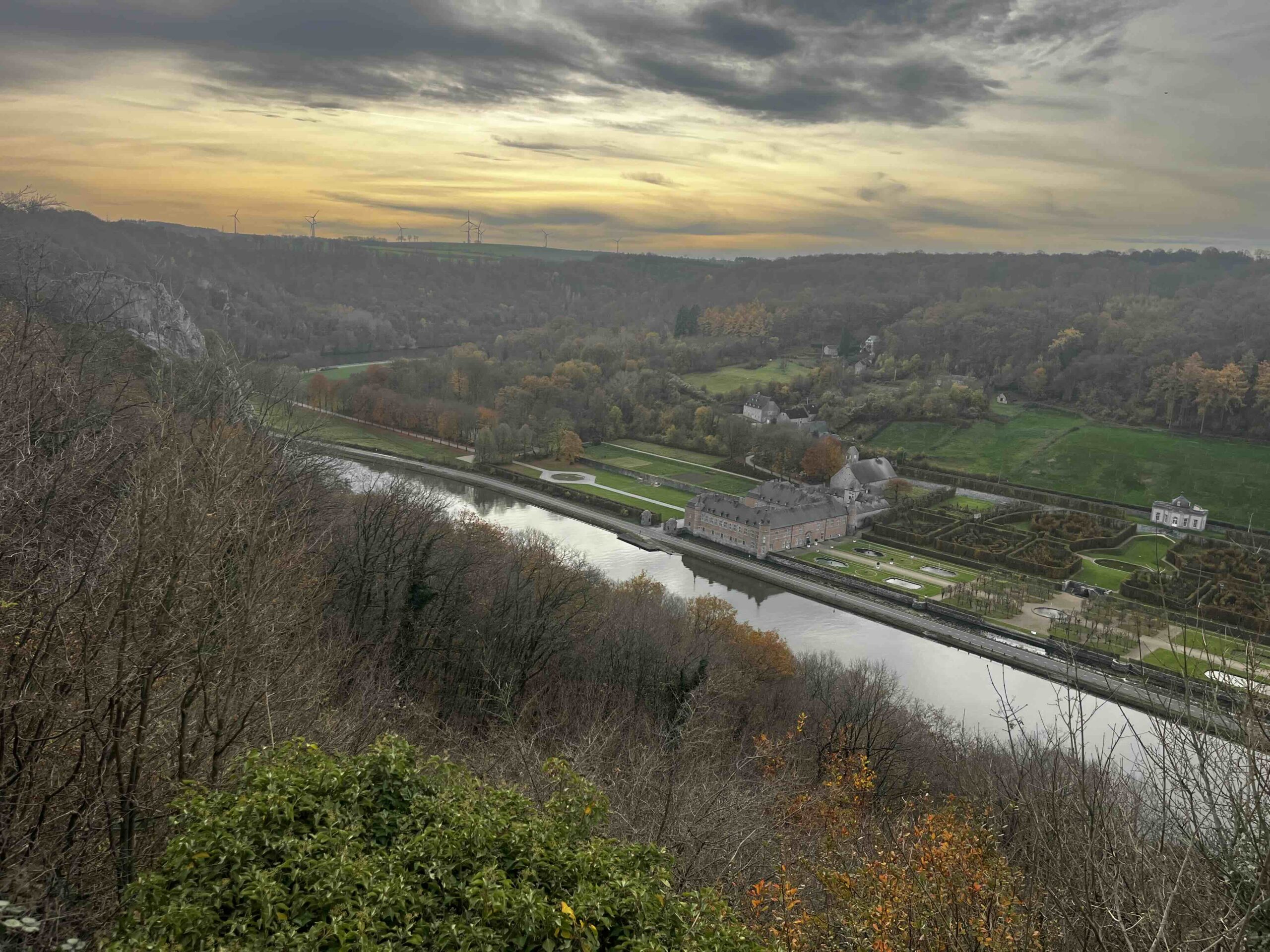
• The Meeting : Here, the contrast is spectacular. On one side, there’s man’s mastery over nature, with French formal gardens designed by Le Nôtre (or one of his pupils), three-hundred-year-old orange trees, fountains, and perfect perspectives. On the other, there’s the raw, vertical nature of the Freÿr rocks, the largest climbing area in Belgium, which rises majestically opposite the castle. It’s the opposition between domesticated nature and wild nature, between the symmetry of classical art and the majestic chaos of geology.
• History : The castle, a former ducal residence, has hosted royalty such as Louis XIV. The Treaty of Coffee (or Treaty of Freÿr) was signed there in 1675 between France and Spain, redrawing the borders of the region. Every avenue of the garden, every room of the castle, breathes this rich European history.
• Nature : The rocks, sculpted by the Meuse River millions of years ago, are home to a unique ecosystem of calcicole plants. It is a site classified as “Exceptional Heritage of Wallonia,” both for its landscape value and its biodiversity.
• The Love at First Sight Experience : Standing at the top of the gardens and contemplating this dual spectacle—the refined beauty of the flowerbeds at your feet and the imposing cliffs on the other side of the river—is to understand the full ambition of the Dukes of Beaufort-Spontin, who sought to integrate their estate into this magnificent landscape.
• Useful link : https://www.freyr.be/
2. The Ruins of Montaigle: The Medieval Fortress Embracing the Rocky Spur
• The Meeting : Montaigle is the perfect example of medieval military architecture adapting to the topography. The fortress is not simply built on a hill; it East The castle stands on a hill. Its walls follow the contours of the rocky spur that overlooks the Molignée valley. Nature provided the natural defenses (the steep slopes) and the building materials (limestone). Man added his strategic genius.
• History : It was one of the most powerful fortresses in the County of Namur. Its destruction in 1554 by the troops of King Henry II of France has preserved the site in its medieval state, making it a leading archaeological site.
• Nature : The site is now a nature reserve. The old walls shelter specific flora and fauna, including cliff-dwelling birds and plants that thrive in dry, stony soils. The view from the top of the ruins over the Molignée valley is particularly beautiful in autumn, It is a reward in itself.
• The Love at First Sight Experience : Climb to the top of the keep and imagine the life of the knights. Observe how each tower and curtain wall was designed to take advantage of the rock formations, the natural defenses, and the strategic viewpoints. It’s an open-air lesson in military strategy, where nature itself is the first line of defense.
•Useful link : https://www.montaigle.be/
3. Furfooz Park: A Journey from Prehistory to the Roman Era in a meander of the Lesse River.
• The Meeting : Furfooz is a condensed history of both human and natural history, all within a mere 50 hectares. In a deep, winding bend of the Lesse River, nature has carved out caves and rock shelters. Since prehistoric times, humans have used these natural defenses as places to settle. The park is like a history book where each page is an element of the landscape.
• History : The site has been occupied almost continuously. It contains prehistoric remains, a Gallic oppidum, a Roman fortress and baths, as well as a medieval fortress. It is an incredible testament to the strategic importance of the location throughout the ages.
• Nature : The park is a remarkably rich nature reserve. The limestone grasslands are home to rare orchids, and the cliffs provide a refuge for numerous birds. The 4-kilometer trail is dotted with spectacular viewpoints overlooking the Lesse River, including the famous “Trou du Grand Duc” (Great Owl’s Hole).
• The Love at First Sight Experience : Descend into the cave called “the Gnomes’ Hole,” imagine our distant ancestors finding refuge there, then climb back up and admire the view from the remains of the Roman baths. In just a few minutes, you traverse millennia of history, with the river below and the surrounding rock as your constant companions.
• Useful link : https://www.parcdefurfooz.be/
These three sites, among many others, perfectly illustrate the promise of our region: never having to choose between a walk in nature and a cultural visit. Here, one goes hand in hand with the other. Every stone has a story to tell, and every landscape is a product of that history. It is this richness, this depth, that we invite you to discover from your base camp in Bonsoy.