Le Fondry des Chiens: descending into the Belgian Grand Canyon
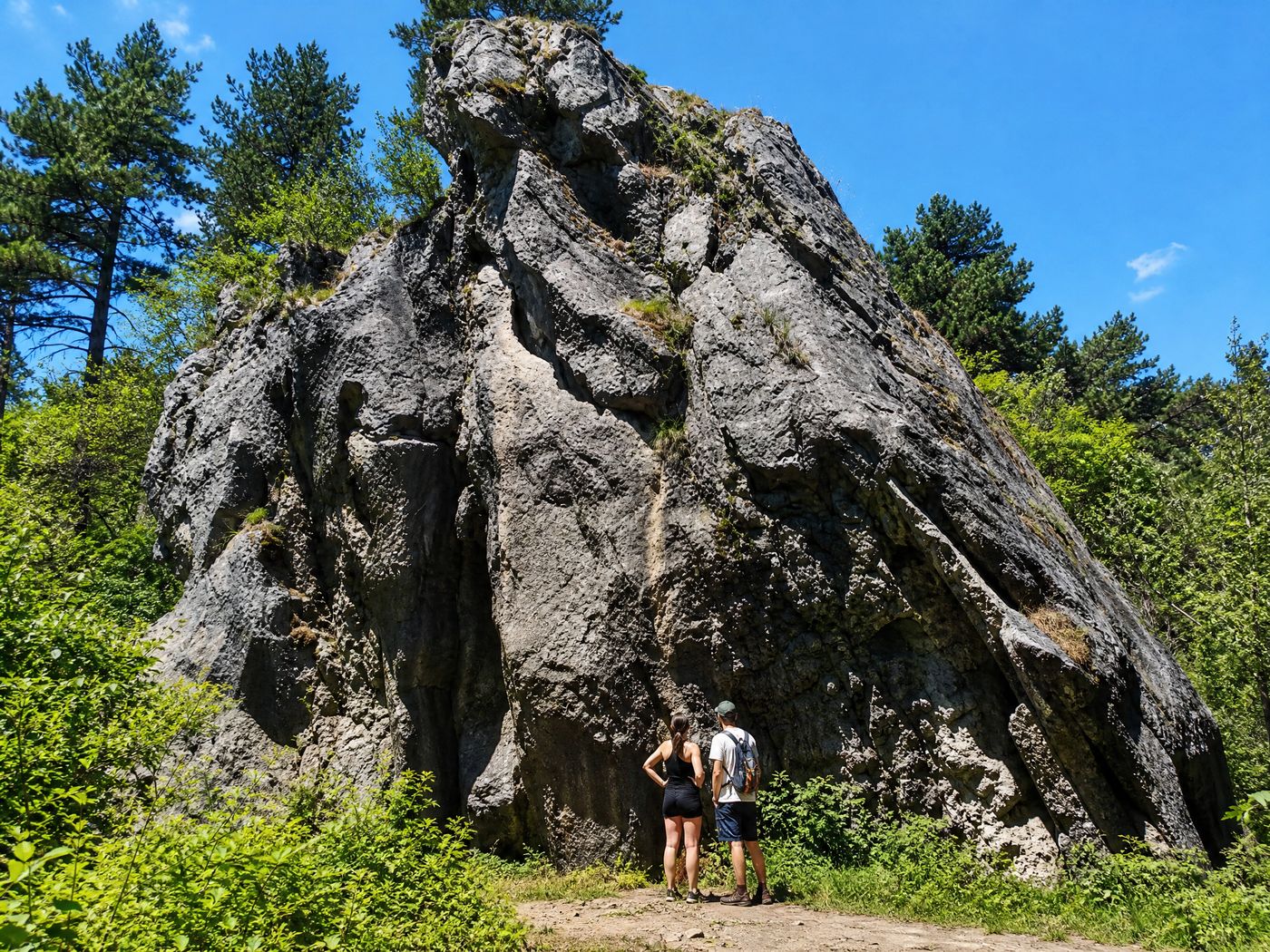
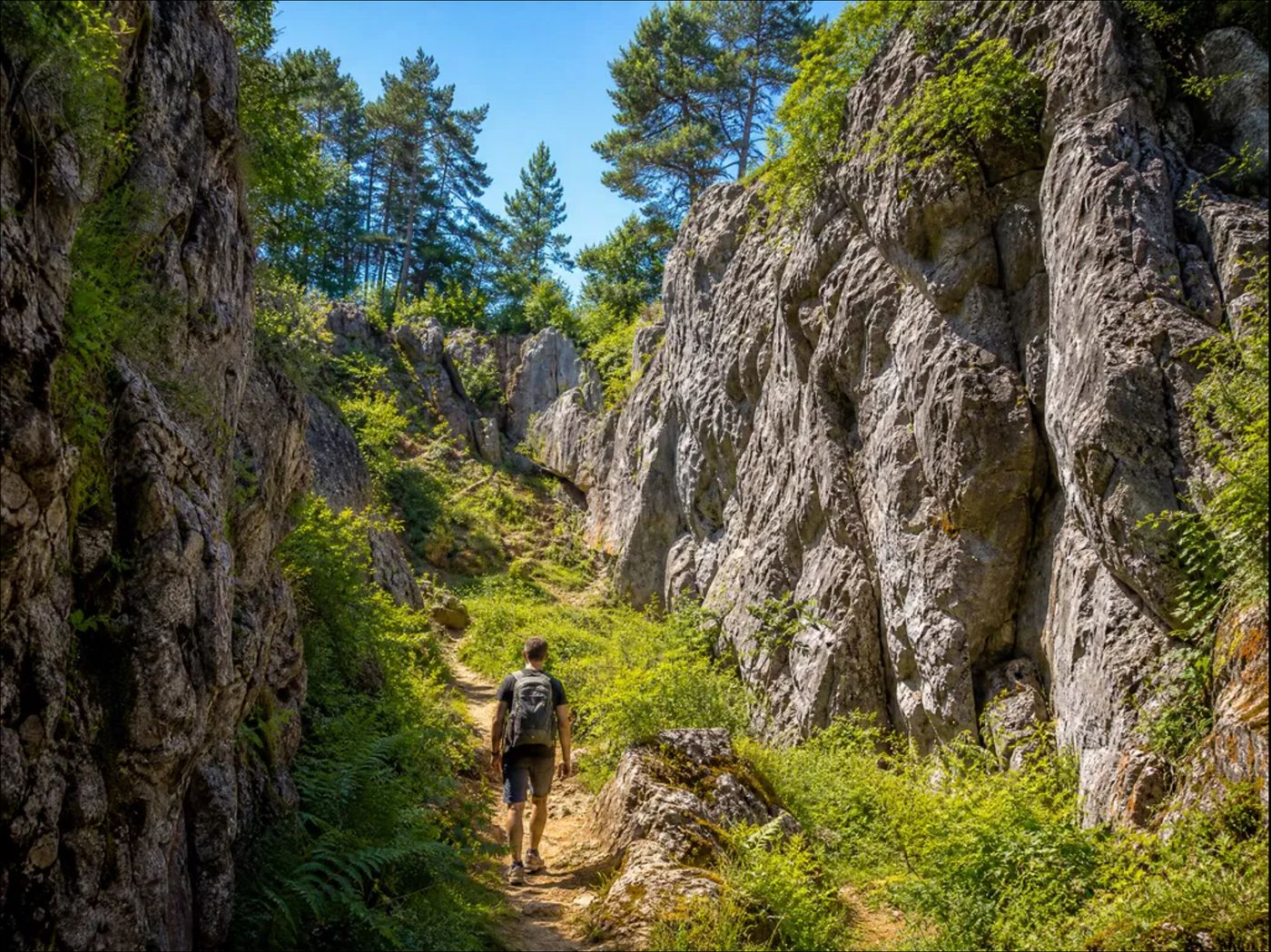
Some landscapes force you to rethink what you thought you knew about your own country. The Fondry des Chiens is one of them. You leave the church in Nismes via an ordinary street, climb for ten minutes between hedgerows, and suddenly the ground opens up. Grey limestone walls rise on either side of the path—riddled with cavities and softened by millions of years of rain—and you find yourself walking along the bottom of a canyon… in Belgium, just thirty-five minutes from your bungalow.
It has been nicknamed the “Belgian Grand Canyon.” While the label may be a marketing ploy, the feeling it evokes is genuine. This chasm reaches depths of up to 20 meters in places and belongs to a geological category found nowhere else in the kingdom but the Viroin region. The site is classified as a natural monument and is fully protected.
We invite you to spend a summer morning there—a time when the light still skims across the rocks and butterflies are just beginning to rise above the dry grasslands.
What exactly is a “fondry”?
The word does not appear in any international geology textbook; it is a local term, rooted in regional dialect. It refers to natural chasms carved into limestone solely by the action of water—not the result of a collapsed underground river, but the patient seepage of rain, century after century, into soft limestone that slowly dissolves.
The result lacks the harshness of a cliff face. What strikes the visitor is the gentleness of the forms: rocks with rounded, almost organic curves, looking as if they were hand-sculpted. The walls are pockmarked with holes, niches, and hollows where moss and ferns cling. It resembles a Mediterranean karst landscape that has been dropped by mistake between the Fagne and the Ardennes.
These chasms are known as “fondrys,” and in Belgium, they are found only in the Viroin region. The Fondry des Chiens is the most spectacular—and the most accessible—example.
As for the origin of the name itself, it remains a subject of debate: several explanations circulate locally, yet none has gained universal acceptance. Perhaps that is for the best. A place like this deserves to retain an air of mystery—much like the legends of the Meuse Valley we told you about last winter.
A biodiversity sanctuary in the heart of the Viroin region
Surrounding the chasm lies a stretch of calcareous grassland—that carpet of short, dry, sun-baked turf that grows on south-facing limestone soils. It is one of Wallonia’s richest yet most threatened habitats.
The soil composition and microclimate foster a level of biodiversity unique within the kingdom. In spring, the grassland is blanketed in the thousands of blue flowerheads of the globe daisy—a small, pom-pom-like flower that gives the site the feel of a Mediterranean scrubland. Wild orchids, thyme, and juniper follow in their wake.
What makes summer different
Many visitors come in the spring for the blossoms. That makes perfect sense—but summer has its own appeal, and it is often underestimated:
- Butterflies. Wallonia’s limestone grasslands are among the best places in the country to spot them. July and August are peak months.
- Grasshoppers and bush-crickets. The ambient sound of a limestone grassland in August is an experience in itself. Close your eyes for a moment.
- The light. White limestone glowing against a deep sky—photographers know that summer is when the Fondry looks its most striking.
- The cool air at the bottom. Paradoxically, it is cooler at the bottom of the sinkhole than up on the grassland. A welcome natural refuge.
If you are passionate about botany and geology, you will find the same processes at work in the Furfooz Nature Reserve—closer to Le Bonsoy—which offers another great lesson in the region’s limestone landscape.
The 6.78 km loop: Fondry des Chiens and Roche Trouée
The Fondry is not a site you simply “visit”; it is a site you traverse. There are no ticket booths, barriers, or opening hours. Access is free and open year-round.
The route
The walk starts at the Nismes church. Several marked trails converge there; the most comprehensive—and our favorite—is a 6.78-kilometer loop that links the Fondry des Chiens with the Roche Trouée, another remarkable geological site in the area.
| Item | Details |
|---|---|
| Start | Nismes Church (parking nearby) |
| Distance | 6.78 km |
| Waymarking | Red rectangle followed by green rectangle No. 1 |
| Estimated duration | 2 to 2.5 hours (including stops) |
| GPX track | Free download from the Viroinval Tourist Office website |
| Guide sheet | €3 from the Viroinval Tourist Office |
| GPS coordinates | N 50°04.222′ – E 4°33.447′ |
Note: the final section, within the village, is not waymarked. Using the GPX track or the printed guide will help you avoid any uncertainty at the end.
Four tips we wish we’d had
- Closed-toe shoes are a must. The trail crosses bare rock that is sometimes slippery and often uneven. Sandals are a bad idea.
- Bring more water than you think you need. Limestone grasslands turn into ovens in August: there is no shade, and the limestone reflects the heat. Allow for 1.5 liters per person.
- Set off early. Before 10 a.m., the light is stunning, the heat is bearable, and you’ll have the site almost to yourself.
- Stay on the trails. The entire site is protected, and limestone grassland is a fragile ecosystem that takes decades to recover. Trampling off-trail is the primary cause of damage.
Seasonal note: hunting takes place in this area. Before setting out, check the hunting schedule published by the municipality of Viroinval or call the Tourist Office. Two minutes spent doing this can save you from an unpleasant surprise.
Visiting with children: yes, but…
The Fondry is an extraordinary playground for children: rocks, narrow passages, and a real sense of adventure. However, it is also a twenty-meter-deep sinkhole featuring unprotected drop-offs.
Our verdict, after visiting as a family: for children aged six or seven and up—provided there are attentive adults and a clear rule not to go near the upper edges—it is a guaranteed success. For younger children, or those with a very adventurous streak, it is better to choose an outing that requires less constant supervision—Chevetogne, for instance, is a perfect choice.
Strollers, however, are completely out of the question.
Nismes and the Viroin: enough to fill your day
Don’t leave right after the loop. Nismes is the heart of the Viroin-Hermeton Nature Park—itself part of the Entre-Sambre-et-Meuse National Park—and boasts a remarkable concentration of attractions per square kilometer.
- Les Jardins d’O, right in Nismes: a landscaped, shady park along the water—perfect for unwinding after a hike.
- The Eau Noire resurgence: the sight of a river re-emerging from the ground, just a stone’s throw from the village.
- La Roche à Lomme, in Dourbes: another limestone outcrop offering a superb panoramic view of the valley.
- Vierves-sur-Viroin, ranked among the Most Beautiful Villages of Wallonia—featuring steep lanes, limestone architecture, and a castle.
- Treignes, the “village of museums”: we dedicated an article to the Espace Arthur Masson there.
- The Three Valleys Steam Railway: we covered the Mariembourg–Treignes route last month.
We had actually touched upon this area in the spring in our article on the wonders of the Viroin. The Fondry deserved a return visit in its own right.
Our perfect day itinerary
Morning
Depart Bonsoy around 8:30 a.m.—the route via Doische and Mariembourg crosses the Calestienne, the limestone strip separating the Fagne from the Ardennes and to which the Fondry owes its existence. Park in Nismes, start at the church, and tackle the 6.78 km loop in the relative cool of the morning. Take your time at the sinkhole: that is the highlight of the trip.
Midday
Return to the village for lunch. Nismes offers several simple dining spots and a thriving local craft scene—bakeries, butcher shops, and regional products. Picnic at the Jardins d’O, weather permitting.
Afternoon
Depending on your energy levels: visit the Eau Noire spring and the Jardins d’O for a leisurely option, or take a detour via Vierves-sur-Viroin and Treignes for a cultural experience. Rail enthusiasts might opt for the steam train.
Evening
Back to Bonsoy in the late afternoon. A shower, the terrace, and that special moment spent looking through the morning’s photos, thinking you never would have imagined such a place existed just thirty-five minutes away. If the sky is clear, linger a while: the Ardennes sky is worth looking up at.
Practical information
- Site: Fondry des Chiens — Viroin-Hermeton Nature Park
- Address: Rue Orgeveau, 5670 Nismes (Viroinval), Belgium
- GPS coordinates: N 50°04.222′ – E 4°33.447′
- Walk start point: Nismes church; follow the red rectangle markers
- Access: Free and open year-round
- Recommended loop: Fondry des Chiens + Roche Trouée, 6.78 km — free GPX track available online; information sheet €3 at the Tourist Office
- Viroinval Tourist Office: +32 (0)60 31 16 35 — tourisme.viroinval@skynet.be
- Website: tourisme.viroinval.be
- Distance from Domaine du Bonsoy: approx. 35-minute drive
- Status: fully protected site, classified as a natural monument
- What to bring: closed-toe walking shoes, plenty of water, a hat, sunscreen
- Check before you go: the hunting schedule published by the municipality of Viroinval
- Not suitable for: strollers, people with reduced mobility
The canyon is thirty-five minutes away. What about you?
People often think you have to hop on a plane to experience that thrill of discovery. The Fondry des Chiens proves otherwise: with just a morning to spare and a good pair of shoes, Belgium reveals a landscape you would search for in vain elsewhere in the country.
Staying at the Domaine du Bonsoy in Hastière makes this an easy, unhurried day trip. Our three bungalows—Birdy, Woody, and Serenity—await you amidst the peaceful trees. Serenity, offering total immersion in nature, is arguably the best base camp for a hiking-focused getaway.
Book your stay at Bonsoy and see for yourself what water can do to limestone given a few million years.