Furfooz: the reserve where the Lesse travels back in time
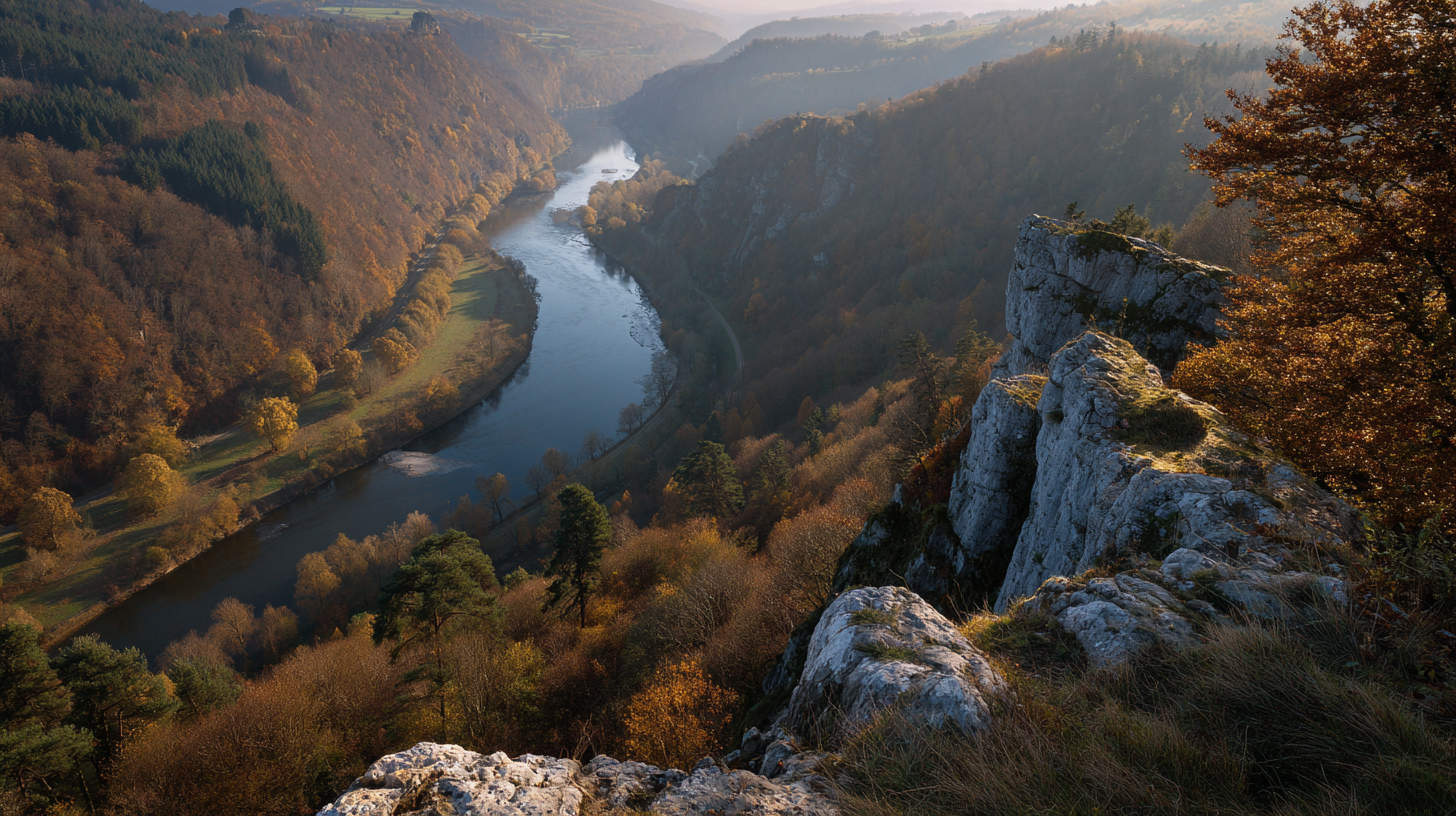
There are landscapes that tell a story and others that hold one within them. Furfooz belongs to the latter category. Across fifty-eight hectares wrapped within a wide bend of the Lesse River, a few kilometers downstream from Dinant, fourteen thousand years of human occupation are layered—from Paleolithic hunters to Roman garrisons, from prehistoric burial sites to medieval hermitages—and all of this is contained within a three-and-a-half-kilometer loop that can be traversed in two hours.
The magic of the place is that you don’t realize it right away. You enter along an ordinary path beneath the beech trees. Then the ground turns to limestone, cliffs appear, a black opening gapes in the rock, and you suddenly understand that these cavities were once homes. A little further on, around a bend, full-scale Roman baths await you in the middle of the forest—like a stage set someone forgot to dismantle.
Ardenne & Gaume, the association that has been looking after the site since 1948, has a lovely way of describing it. : « Furfooz, a little corner of Provence ». Dry limestone grasslands, sun-baked white rocks, and butterflies—six hundred and sixty species of Lepidoptera have been recorded there—give this corner of Wallonia an unexpected Mediterranean feel. Located about a 25-minute drive from the Domaine du Bonsoy, this is the walk we most often recommend to our guests.
A nature reserve, not a park
Let’s start with a detail that will save you from fruitless searches: the site is officially called the Furfooz Nature Reserve, and its website is reservedefurfooz.be. The old name “Parc de Furfooz” still appears in search engine results, often alongside outdated prices. Please rely on the information below and the official page.
The reserve belongs to the City of Dinant and has been managed since 1948 by the non-profit organization Ardenne & Gaume, under a 99-year long-term lease. It covers 58.5 hectares Inside a meander on the right bank of the Lesse, between Houyet and Dinant, on the interfluve of the Ry des Vaux. An intermittent stream, the Sébia, flows there.
Furfooz is not a site to be merely visited; it is a site to be explored on foot. The trail’s fourteen points of interest reveal themselves only to those who make the climb.
The Roman Baths: a full-scale reconstruction
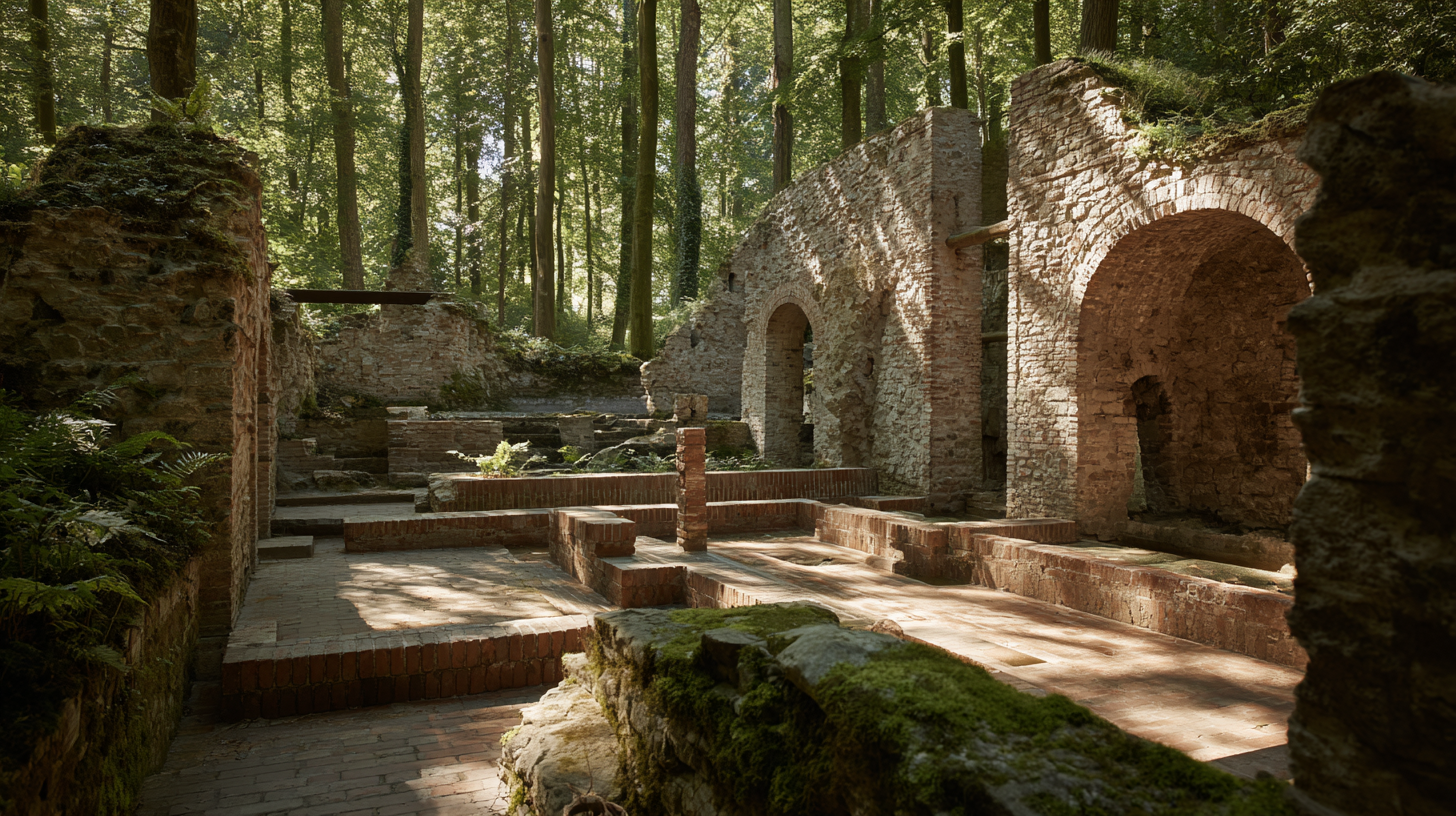
This is the surprise of the tour, and arguably its most striking moment. Towards the end of the Roman era, a garrison stationed on the heights had a bath complex built below. The building survived the centuries in ruins until 1958, when the decision was made to rebuild it entirely to exact scale.
The result is striking. You move through the rooms, distinguishing the *caldarium* from the *frigidarium* and making out the underfloor heating system. The official website puts it bluntly: this life-size monument is worth the trip all on its own.
One detail is dizzying: after being abandoned, these thermal baths were reused as a necropolis by a Germanic community between the 4thandthe Vand century. A place of bathing that became a place of death, and then a place of memory. That is precisely the history of Wallonia, encapsulated in a single building.
The caves, or fourteen thousand years of successive addresses
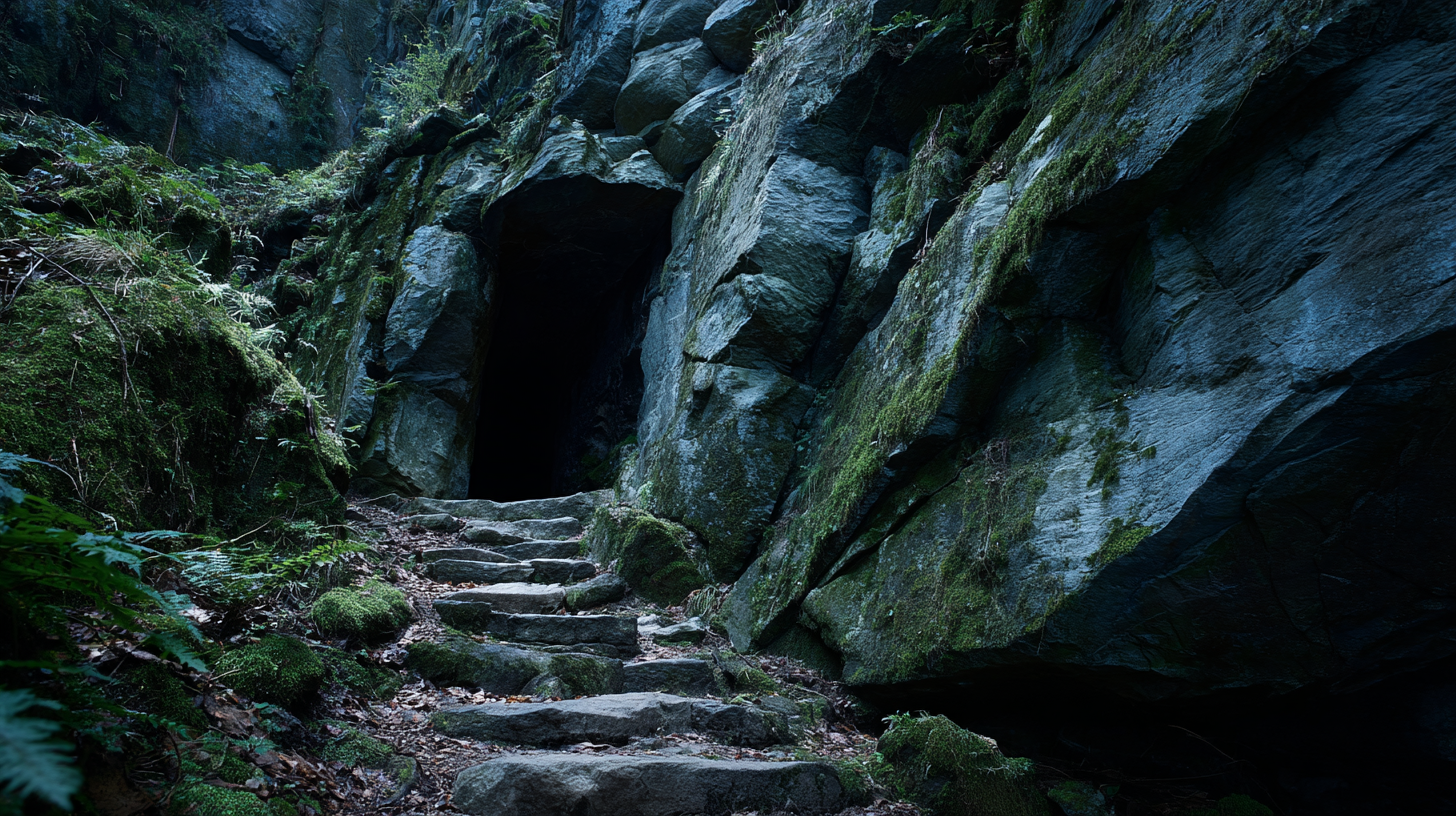
Three caves officially mark the route: the Trou du Grand Duc, the Trou des Nûtons, and the Trou du Frontal. The names of the last two each tell a story.
- The Nutons’ Hole (Trou des Nutons) takes its name from small creatures of Ardennes folklore—dwarf blacksmiths said to inhabit the caves. It did indeed serve as a dwelling—but for humans.
- The Trou du Frontal gets its name from a human frontal bone discovered at the very beginning of the excavations. The name stuck.
The Furfooz caves have been occupied for around 14,000 years, spanning the Magdalenian and Neolithic periods. Along the trail, one can also spot the point where the underground branch of the Lesse begins—the river disappears beneath the rock, just as it does further upstream in the underground network of the Caves of Han.
Édouard Dupont and the Furfooz Man
The name Furfooz entered the history of science thanks to a native of Dinant. In 1864–1865, the geologist and paleontologist Édouard Dupont (1841–1911) He excavates the Trou du Frontal and discovers a collective burial site as well as a series of prehistoric skeletons. His publications — Man during the Stone Ages in the vicinity of Dinant-sur-Meuse, Then The Caves and Underground Rivers of Belgium in 1872 — would make the rounds of the scholarly world in Europe.
The famous “Furfooz Man” was long thought to date from the Paleolithic era. Recent research now links him to the Mesolithic: a Western European hunter-gatherer. Science corrects itself, too—and that is a great story to share with children out on the trail.
Hauterecenne: the fortress above the void
Perched on the ridge overlooking the Lesse River from a height of around one hundred meters stands the archaeological site of Hauterecenne, occupied from prehistoric times until the 13th centurye century. In the 3rde century. The Romans established a Late Empire fortress there—comprising defensive walls, towers, baths, a necropolis, and later a keep—designed to house a Romanized garrison tasked with defending the frontier hinterland. The Franks would go on to ravage it.
The site was listed on July 18, 1980, and recognized as Exceptional Heritage of Wallonia. The panoramic view from the top would justify the climb all on its own: the Lesse river winds its way a hundred meters below, and one instantly understands why so many sought to hold this ridge. Enthusiasts of Meuse Valley fortresses will find the same defensive logic at Crèvecœur, overlooking Bouvignes.
A little corner of Provence: flora and fauna
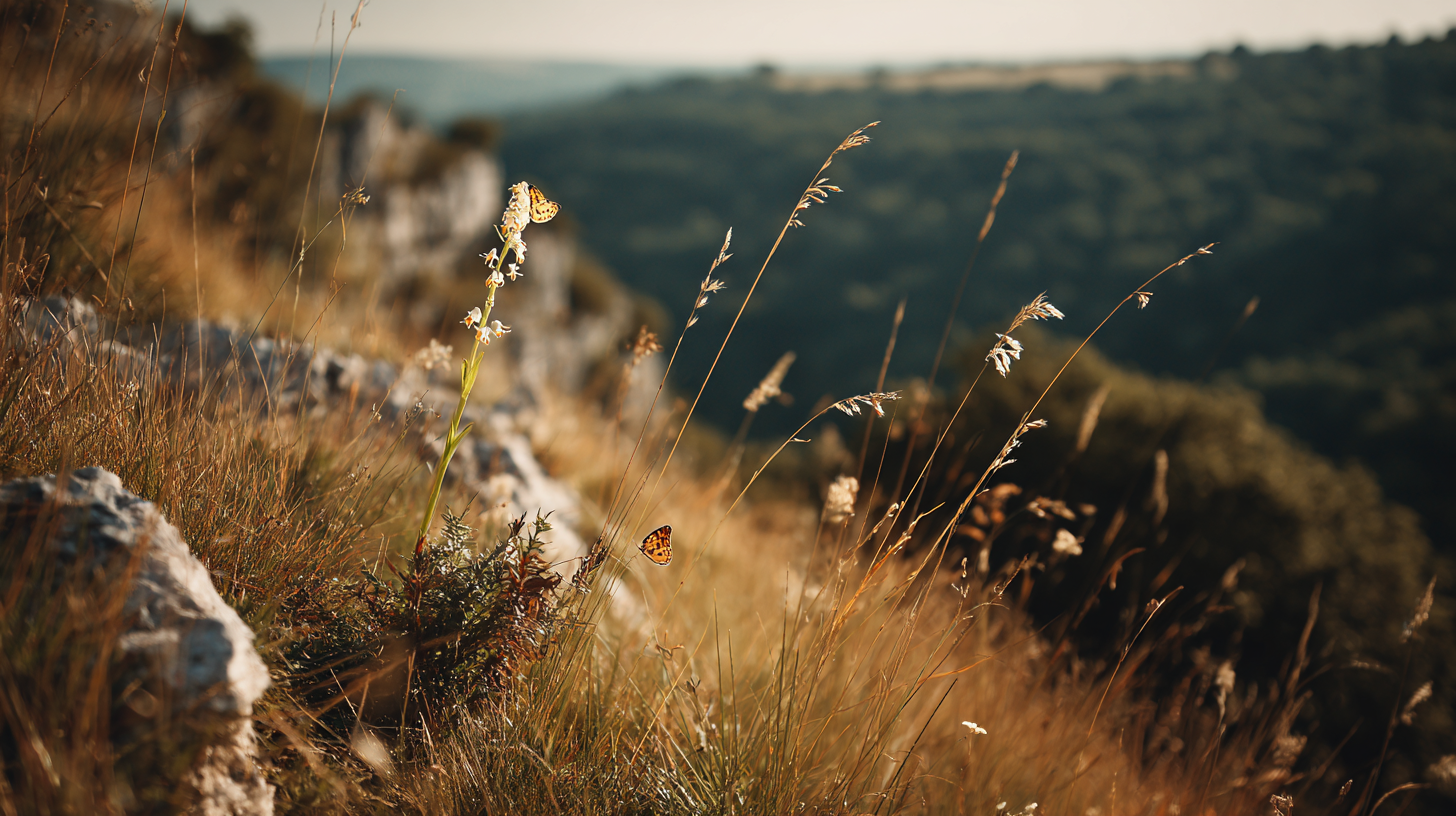
Furfooz packs a rare variety of habitats into a very small area: dry calcareous grasslands, cliffs, ravine maple forests, calcareous beech forests, alluvial forest along the Lesse, and numerous karst features. The grasslands are maintained by sheep—a management method that is as gentle as it is effective.
What you can see
- Limestone grassland flowers: globe daisy, St. Bernard’s lily, mountain St. John’s-wort, round-headed leek, childing pink, and the bee orchid—an orchid that mimics the insect to ensure pollination.
- Rocks and crevices: common juniper, rock fescue, and rustyback fern—a small fern that grows directly on the stone.
- Ravines: hart’s-tongue fern, soft shield-fern, and perennial honesty.
- Butterflies: purple emperor, bramble-feeding fritillary, marbled white, and Adonis blue. 660 species of Lepidoptera have been recorded at the site.
- Birds of prey: common buzzard, European honey buzzard, peregrine falcon, Eurasian eagle-owl, long-eared owl, and tawny owl.
- Along the Lesse: the kingfisher and the white-throated dipper—a small brown bird that walks along the riverbed underwater.
- Bats: underground cavities shelter numerous species, including two types of horseshoe bat: the lesser and the greater.
If birdwatching appeals to you, we have dedicated an entire article to the Aquascope de Virelles and its observation points, located about fifty minutes from Le Bonsoy. The two sites complement each other beautifully: water at Virelles, rock at Furfooz.
Before you go: essential information
Furfooz is a wild, natural site, and it embraces that character. Four points deserve your attention.
1. Dogs are not allowed
Without exception—a rule reiterated on every page of the official website. It is a nature reserve where wildlife comes first.
2. No strollers or wheelchairs
The trail includes steps carved into the rock and is not accessible to strollers or people with reduced mobility. Closed-toe walking shoes are essential. The difficulty level is rated as moderate: it is a family-friendly hike, but not a casual stroll.
3. Weekday roadworks
Since February 2026, roadworks have been affecting access to the visitor center car park. Specifically:
- Monday to Friday (excluding public holidays), access to the Rue du Camp Romain car park may be blocked.
- On weekends and public holidays, this car park remains accessible as usual.
- Alternative car parks: “Traversée du Village” (in front of the Furfooz cemetery; a 1.8 km walk through the village) and “Val de Lesse” (in front of the Gendron-Celles train station; 1.2 km along the river—though currently not recommended due to the risk of the path flooding).
PDF roadbooks are available for download on the official website. It is best to visit on the weekend, but be sure to book ahead: capacity is capped at 300 people per day, and reservations are strongly recommended for Saturdays, Sundays, and public holidays.
4. The reserve may close due to high water levels
During periods of heavy rain, the site may close unexpectedly. Announcements are posted on the reserve’s Facebook and Instagram pages; checking them before you set off will save you from disappointment.
La Flobette: a waterside stop
At the halfway point, the Lesse River flows right beside the path, and a refreshment stop with a terrace awaits you: La Flobette. They serve light vegetarian and “wild-inspired” meals made from local, artisanal, and seasonal ingredients, accompanied by beers from regional craft breweries.
It is open from April to November, seven days a week, from 10 a.m. to 5 p.m., with meals served between 12 p.m. and 3 p.m. One important detail: there is no Bancontact (debit card) facility. Bring cash or use Payconiq. Picnics are permitted provided you buy a drink or snack and take your trash with you.
Our tip: save La Flobette for the return leg. By then, you will have hiked up to Hauterecenne and visited the thermal baths, so you can sit by the Lesse River with the satisfying feeling that you’ve truly earned it.
Extend your day: Celles and Vêves are just a stone’s throw away
The Château de Vêves is located right on Rue de Furfooz in Celles—practically next door. However, do check the schedule, as there is a potential pitfall for visitors in September.
From March 30 to November 1, 2026, Vêves is open only on Saturdays, Sundays, and public holidays, from 10 a.m. to 5 p.m. (last entry at 4:30 p.m.). It only opens daily during the All Saints’ holiday period, from October 19 to November 1. Consequently, it is closed on weekdays between late August and mid-October. Admission is €9.50 for adults and €6.50 for children aged four and up—a price that includes princess and knight costumes, which usually seals the deal for the youngest visitors. We have dedicated an entire article to it.
The nearby village of Celles is also listed among the Most Beautiful Villages of Wallonia. It offers several excellent places to eat, and the Auberge de la Lesse (082 66 73 02)—located at the Gendron-Celles train station, right at the start of the 1.2 km pedestrian path to the reserve—makes for an ideal stop.
Our one-day itinerary for Furfooz
- Morning (9:30 AM) — Depart Le Bonsoy, driving via Dinant and Anseremme. Arrive at the visitor center around 10:00 AM—right at opening time—so you can have the trail to yourself.
- Midday (12:30 PM) — Visit the Roman baths and the caves, then hike up to Hauterecenne for a panoramic view of the river bend. Lunch at La Flobette, by the banks of the Lesse.
- Afternoon (2:30 PM) — Complete the loop through the limestone grasslands, home to various butterflies. Drive to Celles to see the village and its stone houses, plus the Château de Vêves (if visiting on a Saturday or Sunday).
- Evening (6:00 PM) — Return to Dinant via the Lesse Valley, stopping at the confluence in Anseremme to catch the evening light on the Saint-Jean Bridge, before heading back to Le Bonsoy.
Practical Information
Furfooz Nature Reserve
- Address: Rue du Camp Romain 79, 5500 Furfooz (Dinant)
- Telephone: 082 22 34 77
- Website: reservedefurfooz.be
- 2026 Opening Times: April 4 to November 1, daily from 10:00 AM to 4:30 PM (last entry at 4:30 PM)
- Admission: Adults €7.50 — Reduced rate €5 — Children (6–12 years) €2 — Under 6s free — “Visiteur Chaleux-reux” option €10 (admission + support for the expansion project)
- Trail: 3.5 km marked route (blue arrows), 1.5 to 2 hours of walking
- Dogs: Not allowed — Strollers and PRM (People with Reduced Mobility): Not accessible
- Reservations: Highly recommended on weekends, school holidays, and public holidays (maximum 300 visitors per day)
- Distance from Le Bonsoy: Approx. 25 minutes by car
The Flobette (buffet, halfway)
- Phone : 0477 69 08 74 — Website : laflobette.be
- Hours: April to November, 7 h/7 from 10 am to 5 pm — meals served from 12 noon to 3 pm
- Payment: cash or Payconiq only (no Bancontact)
Château de Vêves (nearby)
- Address: Rue de Furfooz 3, 5561 Celles — Telephone: 082 66 63 95
- Opening hours: March 30 to November 1: Saturdays, Sundays, and public holidays from 10:00 am to 5:00 pm — every day from October 19 to November 1
- Admission: Adults €9.50 — Seniors and students €8.50 — Children (aged 4+) €6.50 — Free for children under 4
Returning to the sound of birdsong
After a day spent watching for peregrine falcons on the cliffs and dippers along the Lesse River, it makes perfect sense to return to the Bird House. Our bird-themed bungalow lives up to its name: guests enjoy their coffee while watching the estate’s tits, and conversations begun out on the trail often continue long into the evening.
The region is just waiting to be explored: the Fondry des Chiens in Nismes for another foray into a limestone landscape, the Romanesque abbey church of Hastière just minutes from our bungalows, or the EuroVelo 19 route along the Meuse if you prefer the saddle to the hiking trail.
Autumn is the most beautiful season in the Lesse Valley. The beech forests blaze with color, the trails empty out, and the low-angled light highlights every contour of the limestone. Book your stay at Domaine du Bonsoy now—the reserve closes on November 1st, and it would be a shame to wait until spring.