Bouvignes, the medieval town Dinant almost wiped out
You have driven past it a hundred times. As you head down toward Dinant, just after the bridge, the road runs alongside a row of old limestone facades, a stocky church, and a tiny square—yet you speed on, drawn like a magnet to the silhouette of the collegiate church and the citadel two kilometers further along. That is how Bouvignes has lived for four centuries: in the shadow of its rival.
Yet, there was a time when people fought for this handful of houses. A time when Bouvignes was a strategic stronghold on the Meuse, a border town in the County of Namur, facing Dinant in the Liège region, a city of coppersmiths prosperous enough to attract the covetous eyes of the kings of France. A time when, from atop its rocky spur, the fortress of Heartbreak overlooked the river, and where three ladies, legend has it, preferred the void to capture.
Just twenty minutes from your bungalow, Bouvignes offers one of the finest heritage-focused half-days in the entire Meuse Valley. And, above all, one of the most peaceful—even in the height of August.
The Spanish House: a museum within a monument
In the small Place du Bailliage stands a building one wouldn’t expect to find here: a Renaissance house of stone and brick, with mullioned windows, listed as a historical monument. Exceptional Heritage of Wallonia. It is the “Spanish House,” and for years it has housed the **House of Mosan Medieval Heritage**—or the MPMM, as the regulars call it.
The museum is not large, and that is precisely its strength. A complete visit requires between an hour and an hour and a half, …making it the ideal cultural activity for a summer day: substantial enough to be enriching, yet short enough never to bore the children.
Recognition came quickly. In 2009, the MPMM received the European Union Prize for Cultural Heritage / Europa Nostra Awards in the Education and Awareness-Raising category. In 2011, the Wallonia-Brussels Federation recognized it as a Category B museum. It is not a small village museum; it is a serious museum housed within a village.
The stories told by the permanent collections
The common thread is the Meuse itself—not as a backdrop, but as a character. The river, the town, and the castle. Man and his environment in the Middle Ages. Religious foundations and funeral rites. Ceramics and, of course, the dinner, this art of beaten copper that gave the neighboring town its name and made the fortune of Bouvignes.
“The Meuse—a route of penetration and a strategic commercial artery—constitutes a zone of cultural influence and a coveted territory.” The museum’s scenography embraces the valley. from Sedan to Maastricht : In just one hour, you come to understand why this waterway was so fiercely contested.
If the stories of the valley captivate you, here you will find many echoes of our own. Whispers of history and Meuse Valley legends.
Summer 2026 temporary exhibitions
Two exhibitions are currently in dialogue with each other in the museum’s upper galleries :
- “The Middle Ages in Comics”, open since March 27, 2026. A brilliant introduction for teenagers—and for parents who grew up with it. Johan and Pirlouit or Thorgal.
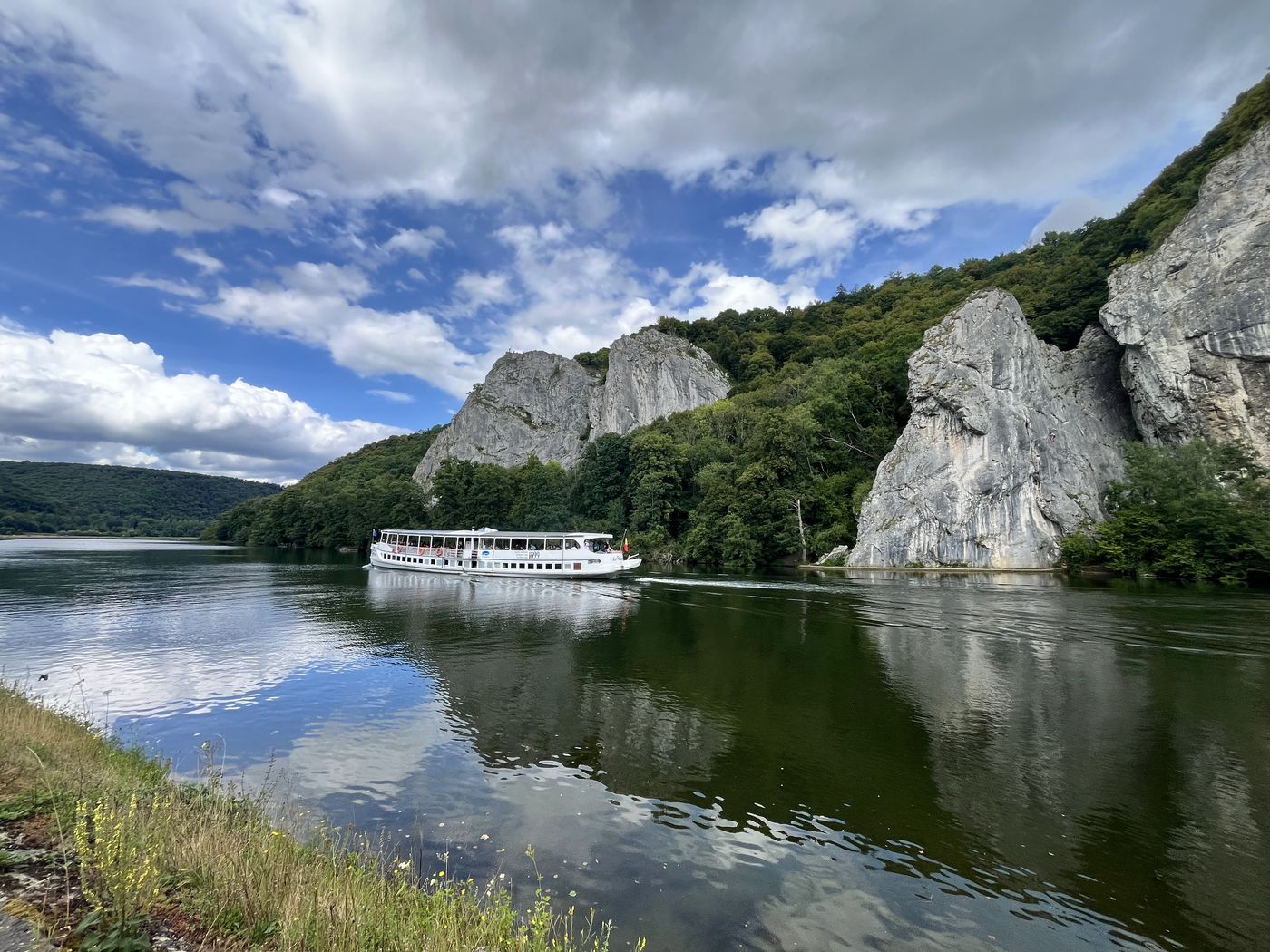
- “The Four Sons of Aymon — the *chanson de geste*”, open since June 26, 2026. The legend of Bayard—the horse said to have leapt across the Meuse—is part of Dinant folklore; seeing it presented in its original medieval version lends unexpected depth to the rock formation you will pass on your way back.
Crèvecœur: a fortress, a legend, a panorama
Above the village, on a spur protected by a defensive barrier and overlooking the Meuse, stand the remains of the Crèvecœur fortress. The original keep is built around 1320 to strengthen the defensive system of the town and the count’s castle. Towards the middle of the 14the century, a “boulevard” was added to protect its western flank; around 1430, a horseshoe-shaped tower was built on the river side. Later, the loopholes were patiently adapted to keep pace with the evolution of firearms—here, medieval military architecture reads like a chronicle.
The fallout originated in France July 8, 1554, Henry II’s troops sacked the town and partially destroyed the fortress. Bouvignes never fully recovered. Despite attempts by Charles V and later Philip II to revive the copper trade, the walls were permanently dismantled in 1672.
The Legend of the Three Ladies
“Since that passing, so noble / Yet one that breaks all our hearts, / The old castle of Bouvignes / Was named Crèvecœur.”
It is a story one does not forget. The city is in flames and under siege; three knights, their wives, and their guard take refuge behind the fortress walls. The women tend to the wounded while the battle rages. Then the walls give way, the knights fall, and the three ladies flee to the highest tower. Seeing the attackers ascending, they make their way to the ramparts, pray—and cast themselves into the void, locked in each other’s arms.
Historiography has long linked the scene to the sack of 1554. Archival research, however, points rather to the siege of 1430. As the museum aptly puts it: is there not a grain of truth in every legend?
A restored site, and a climb that must be earned.
In the 19th century, ill-advised restoration work had rendered the site almost unintelligible. Since 2012, the Wallonia Public Service—which has owned the site since 2003—has carried out consolidation and enhancement work with three objectives: ensuring visitor safety, stabilizing the ruins, and making the monument comprehensible once again. The site is open for independent visits, and the panoramic view of the Meuse loop amply rewards the climb.
Make sure to wear sturdy shoes and bring water, and avoid hiking at midday in August, as the slope faces due south. If you enjoy scenic views, you’ll find other vantage points in our hunt for Meuse panoramas.
On the other side of the river: the limestone grasslands
Opposite Bouvignes, on the far bank, a steep slope is covered with low-growing heathland that naturalists call calcareous grasslands. They owe nothing to chance: as early as the Middle Ages, shepherds drove sheep and goats there to graze, and their browsing prevented the forest from reclaiming the land.
The result is striking. With a south-facing aspect, limestone rock that absorbs the day’s heat and radiates it back at night, and lean, free-draining soil, the site hosts *garrigue* flora right here in Wallonia—including globe daisy, wild thyme, round-headed leek, wild orchids, salad burnet, boxwood, and juniper. It is also home to remarkable butterflies: the Chalkhill Blue, Small Blue, Marbled White, Swallowtail, and Dark Green Fritillary.
August is precisely the best time to observe them. With the disappearance of traditional grazing, these areas are reforesting; several naturalist associations are working to save the most characteristic ones. A direct echo of wonders of the Viroin and its wild orchids that we introduced you to in the spring.
To explore further: Poilvache, the forgotten sentinel
A few kilometers downstream, on the right bank, another spur bears the ruins of Poilvache. Built in the first third of the 13th centurye In the 13th century, under the name “Méraude”, the stronghold passed from the County of Luxembourg to the County of Namur in 1342, then to the Burgundian Netherlands in 1421, before the Prince-Bishop of Liège had it besieged and destroyed during the Summer 1430.
The site impresses with its vast scale : 2,5 hectares fortified sites, housing two distinct entities in medieval writings—the “castle” on the one hand, and the “town” on the other. It was not a princely residence but a sentinel post: its occupants were knights holding a “guard fief,” remunerated with land, rights, and revenues for manning the position.
The MPMM dedicated a digital exhibition to him, What’s new at Poilvache ?, Available online—perfect for planning your visit or extending the experience once you’re back, drink in hand on your bungalow’s terrace. Check the site’s access conditions and opening hours before you go.
The MPMM schedule for August and September 2026
| Date | Activity | Public |
|---|---|---|
| Since March 27 | Exhibition “The Middle Ages in Comics” | Suitable for all audiences |
| Since June 26 | Exhibition “The Four Sons of Aymon — The Chanson de Geste” | Suitable for all audiences |
| August 18 | Craft & Storytime: story reading and collage workshop | Toddlers |
| August 19 | “Journey to the Middle Ages” Illustration Workshop | 7-11 ans |
| 4 september | Board game night | Teens and adults |
| 6 september | Guided tour: tracing Dinant’s medieval heritage | Adults |
| Starting September 12 | Heritage Days: music, theater, stories, and tales | Suitable for all audiences |
The guided tour of the medieval Chestrevin manor on Sunday, August 2, was fully booked. Activities and workshops require reservations; please call or write to the museum before visiting.
Our perfect day itinerary
Morning
A leisurely start from Le Bonsoy around 9:30 a.m.—the road running along the Meuse to Bouvignes is reason enough to set off early. Park in the free public lot, just a stone’s throw from the museum. Head up to Crèvecœur first while the air is still cool: the low morning light sculpts the ruins, and the valley opens up below.
Midday
Head back down to Dinant for lunch, just five minutes away: the quays, the terraces, the cafes along the Meuse. Our The best tables around Bonsoy showcase our favorite spots, ranging from casual brasseries to exceptional Michelin-starred establishments.
Afternoon
Back to Bouvignes for the House of Mosan Medieval Heritage, Open from 10 a.m. to 5 p.m. Spend an hour to an hour and a half exploring the permanent collections, followed by the two temporary exhibitions. Round off your visit with a stroll through the town’s narrow streets—taking in the historic houses, the church, traces of the old ramparts, and that distinctive urban layout: the 12th-century “ladder” plan.e century, still perfectly legible.
Evening
On the way back, a final stop at the Bayard Rock—whose true legend you have just learned. Then Le Bonsoy, the terrace, and the river slowly turning to the color of copper—the very color that made the fortune of Bouvignes.
Practical information
- Name : House of Mosan Medieval Heritage (MPMM)
- Address : Place du Bailliage 16, 5500 Bouvignes (Dinant), Belgium
- Telephone : +32 (0)82 22 36 16
- E-mail : info@mpmm.be
- Website : www.mpmm.be
- Hours : every day except on Mondays, from 10 a.m. to 5 p.m. — 7 days a week for groups of at least 10 people, by reservation
- 2026 Rates : 8 € adult • 4 € Child (6–12 years), student, senior (65+), group of 10 or more, Ligue des familles, large family • 1,25 € Article 27 • free for children under 6, teachers, school groups, and museumPASSmusées holders
- Free of charge : every first Sunday of the month
- Duration of the visit : 1 to 1.5 hours
- Distance from Domaine du Bonsoy : about a 20-minute drive
- Parking : public and free of charge, in the immediate vicinity of the museum
- By bike : accessible via the RAVeL 2, Hastière–Namur section — “Bienvenue Vélo” label, bicycle parking, and repair kit at reception
- By train : Dinant station, a 15–20 minute walk away.
- Note : limited accessibility for people with reduced mobility • no dogs allowed, except assistance dogs • closed on December 24, 25, and 31, and January 1
The Middle Ages await you just twenty minutes away.
There is something deeply satisfying about discovering—after years of merely glancing at it in passing—that the village one speeds past was once a copper capital and a strategic stronghold on the river. Bouvignes does not reveal itself at first glance; it must be earned—and that is precisely why it is so peaceful there.
From the Domaine du Bonsoy, all of this can be done in a single day: the fortress in the morning, Dinant at midday, the museum in the afternoon, and in the evening, the terrace of a bungalow nestled among the trees Woody Lodge, with its warm wood and silence, is undoubtedly the best place to let eight centuries of history rest.
You might also like, in the same vein, our article on Château de Vêves in 2026 and our getaway toNamur and its citadel in summer.
Book your stay at Domaine du Bonsoy and treat yourself to the Meuse Valley just the way we love it: unhurried and uncrowded.